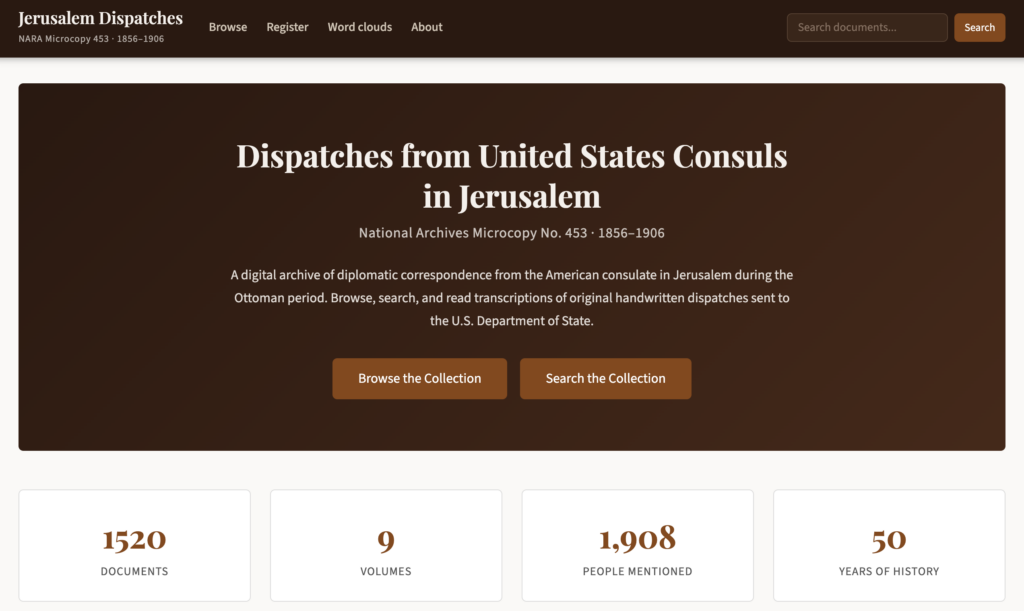
I have a new experimental site up, which allows one to access over 50 years of US Consul dispatches and other documents from their Jerusalem office, over the years 1856 (when the consular office opened) until 1906. These records were photographed and microfilmed in 1969, and over a decade ago I received scans of those microfilms. There were 5 microfilms that contained 9 volumes of documents. The site is online now at consul.quintbooks.com. Go take a look, and see if you find anything interesting.
The original purpose for getting the scans was the idea that there might be genealogically relevant documents in the volumes, although at the time it was too difficult to extract the necessary data from the files. It turned out that the records were somewhat useful when I was researching my edition of Mark Twain’s The Innocents Abroad, as there are many records related to the Adams Colony in Jaffa that is mentioned in the book. I say somewhat useful, as it was still difficult to properly analyze the documents when I was working on my book, and since there are only two footnotes related to the Adams Colony, I couldn’t spend a lot of time deciphering the microfilmed records.
So that brings us to today, when with a lot of help from AI, I was able to analyze thousands of scans, extract the documents, transcribe them, and build a web site to allow others to access everything. I don’t expect all the transcriptions to be completely accurate. That’s really not the point. There are over 1500 documents mentioning almost 2000 people. When possible, I’ve tried to add links to other sites that help add some context. If I can I will add more links to the site over time. Every document page has a comments section, where you can post context and corrections. You can also suggest links for the Learn More section of the document. Right now it tries to link to sites like the State Dept Office of the Historian, where there are biogrpahies of senior State Dept officials that are mentioned in the documents.
What’s interesting about the development of this site, is that 95% of the site was completed in a week. That includes all the transcriptions, and building a working site. For those who have worked with historical documents, and in particular microfilms of those documents, that’s incredible. For those who have developed custom web sites with search capabilities, integration with external services like Disqus, etc. it’s impossible. AI has opened up incredible opportunities for historians and genealogists. Hopefully organizations that have historical documents will all be using AI to make their documents more accessible, but in the meantime, it’s now clear that individuals can fill the gap and build sites like these that provide that access before the organizations catch up.
I’d love to see someone build a similar site to index and translate all the documents Alex Krakovsky has scanned and uploaded from Ukrainian archives (see his section on Wikisources). It’s worth noting that in my new site, when documents are in a language other than English, there’s a button that shows the translation into English. Whereas multilingual sites were quite difficult to build in the past, there’s no reason we couldn’t build a site that works equally well in Ukrainian, English, German, Polish, Hebrew, or any language we want.
I expect there to be some issues with the new site, so if you run into any, send me a message. If you see something wrong with a transcription, make sure to post it in the comments on that site. If you are inspired by this to create your own archival site, post a comment on this post so we all know about it. AI has its share of problems (not least its potential to destroy civilization, or that it’s creating a generation of kids that find it hard to think for themselves), but it’s always nice to see positive developments and I think this is one of them.